Hold on to your butts cause I’m gonna go fast...
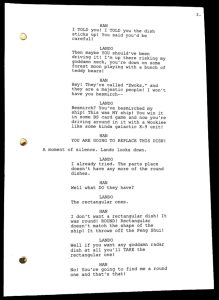
Above is a page from a screenplay, in this case 'Star Wars.' This is what a typical one should look like. Yes, the format looks weird, and there’s a reason. The only thing you need to know right now is this is what it must look like. If not, something’s hinkey
Every screenplay since the caveman starts with two simple words - FADE IN - and ends with two more - FADE OUT. A typical script will have 100 to 200 scenes. A scene header is called a slug line. A slug line consists of three parts. They always start with one of two abbreviations - INT. for interior or EXT. for exterior. This tells the crew whether they should bring a coat to the set.
Next is the SETTING. It may be specific if it’s integral to the plot, like EMPIRE STATE BUILDING in 'Sleepless in Seattle' otherwise it might be vague like NEW YORK CITY MIDTOWN STREET. Production people will decide precisely where in Midtown or maybe Toronto if they have no budget.
The final piece is the when - it should be DAY or NIGHT. Anything else like A QUARTER PAST MIDNIGHT DURING A WAXING GIBBOUS is no good. It might also say MOMENTS LATER, which means if it was DAY in the preceding scene, it’s still DAY, just the placement of the camera has changed. Or CONTINUOUS for , um, continuous action. So pay attention.
NEXT comes ACTION. Action describes what is going on. It may be detailed; in my scripts, check that, it will be scant or, as I like to put it, economical. A few years back, I had dinner with my cousin Elias, who is a film director. I asked him if this is a sufficient action line - “Elias and Henry sit at a dining table eating.” He said, “ You bet, because I'm gonna ignore it since it’s my film now." Thus, you may need some clues as to whether they are eating in a Beverly Hills apartment or Versailles in the 16th century. So look for them.
After that come the CHARACTERS. The first time a character appears in the action, their name will be in ALL CAPS, upper and lower, thereafter. That way you know it’s their initial appearance. Name should be followed by an age and short description.HENRY, 59, boyishly handsome.
Names should be distinctive, meaning if they’re all Ken, Jen, Ben or Bill, Will, Jill, you’ve got a problem. Iago, Desdemona, and Othello work better. Remember, as the reader, you can’t fix bad naming, so you will need pay strict attention. One trick is to print the script and use different highlighters. Or burn it.
With ages, while there may not be much difference between, say, 56 and 59, there most definitely is between 16 and 19. So, if the description says TEENAGER, feel free to jump up and stamp your feet in anger. Now, here’s where things get tricky.
It may help to imagine an actor playing the role - in my case, George Clooney naturally. But unless your side hustle is casting agent, this could be a bad choice as he might be, as they say on Broadway, the right actor in the wrong role. With rare exceptions I never imagine a particular actor when writing or reading scripts but do whatever works for you.
Characters speak DIALOG. The heading will be the character’s name followed by the words they will utter. It’s that simple.
Finally, one other element that should not be overlooked are parentheticals. They will rear their heads early and often. They show up at the end of slug lines, like, (FLASHBACK). So again, pay attention. They also appear in DIALOG such as (Reading) if a character is, well, reading something or (CON’T) if the character has had their soliloquy interrupted by action. You may also see (V.O.) which means VOICEOVER like Red in 'Shawshank' or (O.C.), OFF CAMERA. In this case, the actor is in the scene just not in the frame.
Now, it can be a challenge to guess the spoken tone when reading dialog so look for clues like exclamation points and ALL CAPS. I like to use ellipses to simulate a character pausing for a beat. I try to use parentheticals sparingly as they tend to gum up your reading. Overuse of parentheticals leads to what’s called ‘directing from the page’ which is considered bad form.
There, that’s it. That’s pretty much what you need to know to navigate a script. On a film set, wardrobe people dress the actors, makeup folks make them look pretty, assistant directors tell them where stand. Just like kindergarten. Our job as writers is simple - we put words into the actor’s mouths; the director makes their lips move.
As the reader, you are all these things and more only in your minds eye so imagine the scene in a way that speaks to you. Remember, there is no right or wrong! A hundred people will visualize a script a hundred ways and they can all be great. Or not.That’s it.
For a more in depth understanding, read How to Read a Screenplay, Part II.