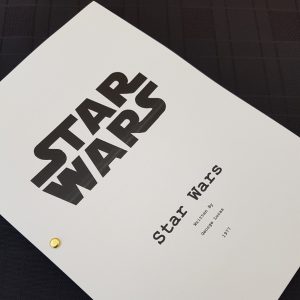
Screenplays have been around in some way or shape since Edison. The modern format dates to the 1940’s or thereabouts and is a byproduct of the Hollywood studio system. Back in the day, when scripts were printed not pdfs, studio exec would check the weight before reading. Heavy meant long. Next, they would flick through to check the color. Dark meant lots of words.
Movie folks didn’t get into the biz because they like to read otherwise they’re have become librarians. They like pretty pictures. Thus, heavy, dark scripts were often relegated to the bottom of the stack, sometimes referred to as the slush pile.
To begin, let’s take a closer look at the screenplay format. It’s just plain weird. It employs a monotype font, 12 point Courier (just like this page). There’s a lot of blank space. The primary reason for the design is, in theory, each page approximates one minute of screen time, thus a 120 page script is a two hour movie. Except when it isn’t. More on that shortly. The ample white space also allows for copious notes which, as as I can attest, may or may not be a good thing.
The main character in a script is called the protagonist. In a well crafted work, he or she will face an antagonist although sometimes, the opposing forces may only be in his or her head. And yes, there must be opposing forces. He or she will also be forced to make choices, ofttimes gut-wrenching. If not, then they are considered “along for the ride” which is bad.
There are but seven story archetypes according to Christopher Booker’s 2004 book — overcoming the monster, rags to riches, the quest, voyage and return, comedy, tragedy, and rebirth. Whatever story you’re reading will fit into one of these, at least it better or stop reading. There are also many genres - drama, action, comedy, sci-fi, you know the rest. In Hollywood, they tend to go in and out of fashion. As of this writing, horror is all the rage, but wait five minutes.
Most, if not all, stories follow a three act structuret. Act one is the setup, act two a bunch of shit happens, act three winds down to the conclusion. If a script is destined to fail, odds are it will do so in the second act. In a 95-page screenplay, act one will be 20 pages, act two 60, act three 15. Give or take.
The story arc is known as the plot. There are often subplots that intertwine with the main story or sometimes, they appear to be completely separate. They’re not. At some point, they should converge or something’s messed up. Or the writer is building in a sequel. Same holds for characters. If they disappear for too long, it’s called “falling by the wayside.” It’s only a bad thing if you think to yourself while reading, “Whatever happened to Baby Jane?”
Somewhere in the first act there will be an inciting incident, an event that kicks off the action. Folks in what I call the Screenwriting Industrial Complex or SIC for short recommend writers make it early, even page one. That’s silly. It just needs to be in the first act so if you’re on page 57 and it hasn’t happened, you should punt. These same sycophants also suggest you make your first ten pages kick-ass otherwise the reader will never make it to page 11. I even heard an exec say he could tell by page one if a script was any good.
All this nonsense is stupid and shortsighted and it makes my blood boil. Every page must be kick-ass. But there’s the world as it is or as you’d like it. Pick one. You’ll know a great script if by the end, you’re first thought is — "God, I wish there was more!"
In his 1982 classic, “Adventures in the Screen Trade”, the two-time Academy Award winning screenwriter William Goldman suggests 90 to 135 pages is the proper length for a screenplay. More recently, I heard a screenwriting teacher utter, and I quote, “your screenplay must be 95 to 105 pages. If not, no one will read it.” My first thought was, there are eight billion people on Earth. That’s a lot of folks not reading my work.
To illustrate this obsession with page count, the world-class writer Aaron Sorkin submitted a draft for The Social Network that was un-godly big. Studio execs told him to take a hike. He said it’s a two hour movie. They scoffed. So he said, “Don't you know who I am?” They were unmoved. So he did what any writer with an unlimited bankroll would do. He hired actors, set up what’s known as a table read and invited execs to attend. Professional actors read the script end to end and guess what? Two hours. Problem solved! For the record, the final cut of the film clocks in at exactly 120 minutes.
Funny thing is, most execs will never actually read the script. How do you like them apples, Matt Damon? They’ll hire what’s called a coverage reader who, for 40 bucks, will summarize and makes notes. Yes, the writer’s fate is in the hands of some 22-year-old USC film grad who only got accepted because he was the best fake rhythm gymnast in all of Moose Jaw, Saskatchewan.
Moving on. Better scripts do more showing, less telling. So, when reading, you will need to tax your imagination! Characters should demonstrate their thoughts. Dialog should have subtext - saying one thing and meaning another. Just like your significant other. If you find a character speaking their thoughts, otherwise known as spot-on dialog, that’s another red flag. After all, it’s a fucking movie.
Remember - every noteworthy film since the Lumiere Brothers has one and ONLY one thing in common. They are all great stories. Period. Mr. Goldman said it best - NOBODY KNOWS ANYTHING. Not one person in the entire motion picture field knows for a certainty what’s going to work. Thus, you my dear viewer, are just as qualified as anyone in Tinsletown to pass judgment on whether a particular work is screenworthy.
One final word of caution. We all have strong genre preferences, just don’t let them carry too much weight when passing judgment. It’s up to you to recognize the great film from the written word, even if the plot isn’t your prefered cup of flat white.
And one more last last thought before I go and this is just my opinion and has zero basis in fact. You should read a script in one sitting. It’s not a novel where you can pick up where you left off. Find a quiet spot, shut that stupid cellphone off and immerse yourself. And if you’re truly ambitious - read it aloud!
Even heavy scripts - 'Pink Rabbits' is 162 pages and it’s a masterpiece, if I say so myself - should only take an hour or so for anyone possessing a fifth grade reading level. Think of it just like being in the theater except with better lighting and no Twizzlers.That’s it.
Have fun storming the castle!